

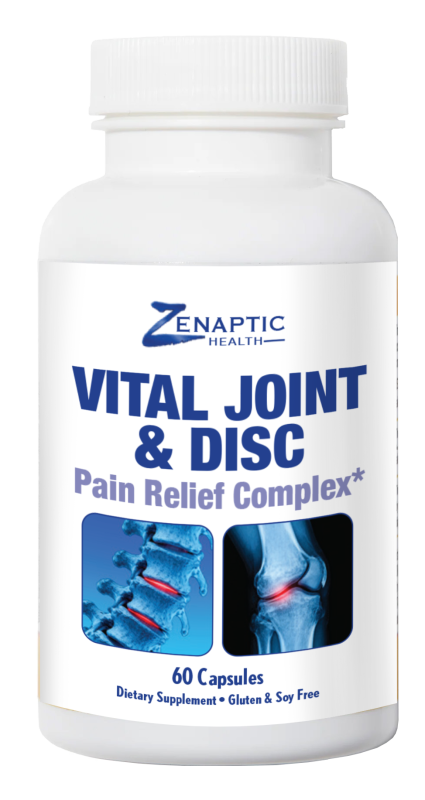
Vital Joint & Disc
Vital Joint & Disc Pain Relief Complex
For Natural Pain Relief
NATURAL INGREDIENTS
Disc and joint pain relief complex consist of the following natural pain relieving agents for sufferers of course Roddick type back pain and neck pain:
• 800 mg (Curcumin the active
compound in turmeric)
• 200 mg ginger root 5% extract
• 100 mg white willow bark
• 100 mg boswellia serrata extract
• 100 mg quercitin
• 50 mg devil’s claw powder
• 50 mg valarian root 0.8% extract
• 50 mg passion floewr 4:1 extract
• 50 mg turmeric 12:1 extract
• 20 mg black pepper (piperine)
1920 mg TOTAL PER SERVING
Suggested use take 2 to 5 capsules daily, preferably with meals, or as directed by a doctor or healthcare provider.*
Information gathered and shared by Zenaptic Health, LLC.
References are available at www.
* None of the statements in this informational brochure have been evaluated by the food and drug administration. This product is not intended to diagnose, treat, cure or prevent any disease.
BUY NOWWhen working with back pain and neck pain patients, pain relievers are part of the plan. Back pain often interferes with the daily activities of life for many, yet the oft-prescribed drugs may also cause issues.
So, Vital Joint & Disc Pain Relief Complex is a supplement that combined some of the most highly evidenced and research natural pain relieving agents. The following summaries show the potential benefits for pain patients.
A review of 10 different studies states that Devil’s Claw (harpagophytum procumbent) and White Willow Bark (salix alba) are found to be effective in low back pain relief when compared to a placebo, no treatment, and standard treatment. The use of Devil’s Claw is strongly evidenced for short term improvement in pain. The use of White Willow Bark was moderately evidenced for short term improvement. (1) – see references below.
White Willow Bark extract (Assalix) offers analgesic an anti-inflammatory action. Patients from 30 to 74 years of age report a decrease in the intensity of the low back pain as well as significant improvement of spinal function in the quality of life. (2)
Boswellia reduces inflammation, pain and swelling, and may be better than osteoarthritis drugs for osteoarthritis. Boswellia’s effects on arthritis may take a little longer to notice, but they last. One study compared Boswellia to drug therapy and found Boswellia’s effects last even a month after not taking it, whereas patients who took the drug were back to square one. (3)
New studies about curcumin, the active ingredient/plant pigment in turmeric, offer hope for pain relief in conditions like osteoarthritis, with pain- and inflammation-reducing properties. Ginger root does, too, and enhances the absorption of turmeric and curcumin. For patients who take NSAIDs and experience undesirable side effects or find them not effective enough, taking curcumin may well relieve the pain sufficiently to make the pain tolerable without the side effects. (4)
Curcumin is a diarylheptanoid, the principal curcuminoid of turmeric. Curcuminoids are natural phenols believed to be anti-inflammatory, anti-oxidant, and perhaps even anti-cancer. (5)
Curcumin eases chronic pain and improves memory deficits linked to long-term sciatic nerve constriction. (13) For osteoarthritis, rheumatoid arthritis, and even back pain, the anti-inflammatory properties are beneficial. (5, 6)
Black pepper (piperine, its key component) enhances the bioavailability of curcumin by 2000% (12)
Degenerative joint disease is improved in a study that had acute and chronic pain patients dealing with osteoarthritis take natural anti-inflammatory agents like Devil’s Claw and turmeric (Curcuma longa). (6)
Quercitin is a flavonoid, a plant pigment that gives fruits and vegetables their color. Quercitin has anti-inflammatory and antioxidant properties. It seeks out free radicals in the body to get rid of them and stabilizes cells that release histamine which thereby has an anti-inflammatory effect. (7, 8, 9)
Passion flower in Valerian root are included for the calming and relaxing affects as they increase the level of gamma amino butyric acid (GABA) in the brain to help regulate nerve cells. (10,11)
So for back and neck patients who want a more natural approach to pain control, these natural substances may be an answer.
Zenaptic Health
14313 NE 20TH Ave, Suite 101B
Vancouver, WA 98686
(360) 260-6903
Disc & Joint Pain Relief Complex
-
Gagnier JJ, van Tulder M, Berman B, Bombardier C: Herbal Medicine for Low Back Pain: A Cochrane Review. Spine
2007; 32(1):82‐92
-
Povoroznyuk W, Karasevskaya T: Study of efficacy and safety of willow bark extract (Assalix) in treatment of
chronic low back pain in patients of different ages with osteochondrosis. Proceedings of the 13th International Pain
Clinic Congress: World Society of Pain Clinicians, 2008: 149‐153
-
Bone K: Boswellia: A new herbal breakthrough for osteoarthritis. Sourced 3/10/14.
https://www.painfulbackpain.com/corporate/uploads/Boswellia.pdf
-
Cao H, Zheng JW, Li JJ, Meng B, Li J, Ge RS. Effects of curcumin on pain threshold and on the expression of nuclear factor κB and CX3C
receptor 1 after sciatic nerve chronic constrictive injury in rats. Chin J Integr Med. 2014 Jan 28. [Epub ahead of print]
-
WebMD: Turmeric. https://www.webmd.com/vitamins‐supplements/ingredientmono‐662‐
TURMERIC.aspx?activeIngredientId=662&activeIngredientName=TURMERIC. Sourced 2/17/14
-
Conrozier T, Mathieu P, Bonjean M, Marc JF, Renevier JL, Balblanc JC. A Complex of Three Natural Anti‐inflammatory Agents Provides
Relief of Osteoarthritis Pain. Altern Ther Health Med. 2014 Jan;20 Suppl 1:32‐7.
-
Davis JM, Murphy EA, Carmichael MD, Davis B (April 2009): “Quercetin increases brain and muscle mitochondrial biogenesis and exercise
tolerance”. Am. J. Physiol. Regul. Integr. Comp. Physiol. 296 (4): R1071–7. doi:10.1152/ajpregu.90925.2008. PMID 19211721.
-
Stewart LK, Soileau JL, Ribnicky D, Wang ZQ, Raskin I, Poulev A, Majewski M, Cefalu WT, Gettys TW (July 2008): “Quercetin transiently
increases energy expenditure but persistently decreases circulating markers of inflammation in C57BL/6J mice fed a high‐fat diet”. Metab.
Clin. Exp. 2008;57 (7 Suppl 1): S39–46.
-
“Quercetin.” University of Maryland Medical Center. Sourced 3/10/14, https://umm.edu/health/medical/altmed/supplement/quercetin
-
“Passionflower.” University of Maryland Medical Center. Sourced 3/10/14, https://umm.edu/health/medical/altmed/herb/passionflower
-
“Valerian Root.” University of Maryland Medical Center. Sourced 3/10/14, https://umm.edu/health/medical‐reference‐
guide/complementary‐and‐alternative‐medicine‐guide/herb/valerian
-
Prasad S, Tyagi A, Aggarwal B: Recent Developments in Delivery, Bioavailability, Absorption and Metabolism of Curcumin: the Golden
Pigment from Golden Spice. Cancer Res Treat. 2014 Jan; 46(1): 2–18.
-
Du J, Deng Y, Qiu Z, Sun G, Guo Y, Hei Z, Li X. Curcumin Alleviates Chronic Pain and Improves Cognitive Impairment via Enhancing
Hippocampal Neurogenesis in Sciatic Nerve Constriction Rats. J Pain Res. 2021 Apr 20;14:1061‐1070. doi: 10.2147/JPR.S299604. PMID:
33907454; PMCID: PMC8069680.
VIDEO:
-
Xiao L, Ding M, Fernandez et al: Curcumin alleviates lumbar radiculopathy by reducing neuroinflammation, oxidative stress and nociceptive factors. Eur Cell Mater 2017;33:279‐293
-
Sanivarapu R, Vallabhaneni V, Verma V. The Potential of Curcumin in Treatment of Spinal Cord Injury. Neurol Res Int. 2016;2016:9468193. doi: 10.1155/2016/9468193. Epub 2016 May 19. – Curcumin shows superior results over corticosteroids.
-
Taverna S, Giallombardo M, PUcci M, Flugy A, Manno M, Raccosta S, Rolfo C et al: Curcumin inhibits in vitro and in vivo chronic myelogencous leukemia cells growth: a possible role for exosomal disposal of MRI‐21. Oncotarget 2015; 6(26):21918‐33 ‐ Curcumin exhibits antitumor activities in many human cancers.
-
Vidal B, Vazquez‐Roque R, Gnecco D et al: Curcuma treatment prevents cognitive deficit and alteration of neuronal morphology in the limbic system of aging rats. Synapse 2016 Dec 20. – Curcuma prevents aging and improves memory.
-
Wang YF1, Zu JN1, Li J2, Chen C3, Xi CY1, Yan JL4. Curcumin promotes the spinal cord repair via inhibition of glial scar formation and inflammation. Neurosci Lett. 2014 Feb 7;560:51‐6. doi: 10.1016/j.neulet.2013.11.050. Epub 2013 Dec 4. – Curcumin promotes spinal cord repair by inhibiting glial scar formation and inflammation.
-
Machova Urdzikova L, Karova K, Ruzicka J, Kloudova A, Shannon C, Dubisova J, Murali R, Kubinova S, Sykova E, Jhanwar‐Uniyal M, Jendelova P. The Anti‐Inflammatory Compound Curcumin Enhances Locomotor and Sensory Recovery after Spinal Cord Injury in Rats by Immunomodulation. Int J Mol Sci. 2015 Dec 31;17(1). pii: E49. doi: 10.3390/ijms17010049. – Curcumin – anti‐inflammatory, therapeutic for spinal cord injury especially immediately after injury.
-
Meng B, Shen LL, Shi XT, et al. Effects of curcumin on sodium currents of dorsal root ganglion neurons in type 2 diabetic neuropathic pain rats. Zhongguo Ying Yong Sheng Li Xue Za Zhi. 2015 Nov;31(6):541‐8. – Curcumin ameliorates DRG neuropathic pain.
-
Ma J, Yu H, Liu J, Chen Y, Wang Q, Xiang L. Curcumin promotes nerve regeneration and functional recovery after sciatic nerve crush injury in diabetic rats. Neurosci Lett. 2015 Nov 6. pii: S0304‐3940(15)30242‐1. doi: 10.1016/j.neulet.2015.11.005. [Epub ahead of print] – Curcumin promotes peripheral nerve regeneration.
-
Oltean H, Robbins C, van Tulder MW, Berman BM, Bombardier C, Gagnier JJ. Herbal medicine for low‐back pain. Cochrane Database Syst Rev. 2014 Dec 23;12:CD004504 – White willow bark and Devil’s claw effective for LBP treatment, probably better than placebo for short‐ term improvements in pain and rescue medication.